
About
I’m a data scientist and ML researcher with a physics foundation (B.Sc. through Bar-Ilan’s program for youth gifted in mathematics) and years of applied quantitative work. I led an Operations Research and Data Science team in Unit 8200 — hiring, mentoring, and shipping end-to-end ML pipelines — then built statistical models in the IAF’s Operations Research Branch, work recognized with the Israel Defense Prize. In my research M.Sc. at the Hebrew University I work on machine learning for formal reasoning; my thesis reads a frozen theorem prover’s internal states to predict, early, which proof attempts will fail, where a verifier, not a leaderboard, decides what counts. Across all of it I build ML systems with careful evaluation, reproducible experiments, and statistically grounded analysis — I try not to trust a number until I understand how it was produced.
- 2024–Present IAF Operations Research Branch · Israel Defense Prize
- 2023–Present M.Sc. Computer Science (research), Hebrew University of Jerusalem
- 2022–2024 Unit 8200 · Operations Research & Data Science team lead
- 2018–2021 B.Sc. Physics, Bar-Ilan University (gifted-in-math program)
Featured projects
-
Internal-State Probes for Kernel-Verified Theorem Proving
My M.Sc. thesis: small probes read a frozen prover’s hidden states mid-proof and tell, early, which attempts will never close the goal.
- Problem
- A prover samples many proofs per theorem and keeps whichever one Lean accepts, so most attempts are wasted — and the worst ones loop until the token cap, one of them re-emitting the same rewrite lemma 208 times. On the 8B model, 24.4% of failed attempts run longer than anything that ever verified, consuming 49.2% of all generated tokens.
- Method
- MLP and LSTM heads under 3M parameters read the frozen Goedel-Prover-V2’s hidden state at each proof-line start and predict failure, then feed that probability back into generation. Labels come from a robust verification protocol: every proof recompiled in a fresh Lean process, accepted only if it type-checks with no “sorry” and rests on trusted kernel axioms alone.
- Result
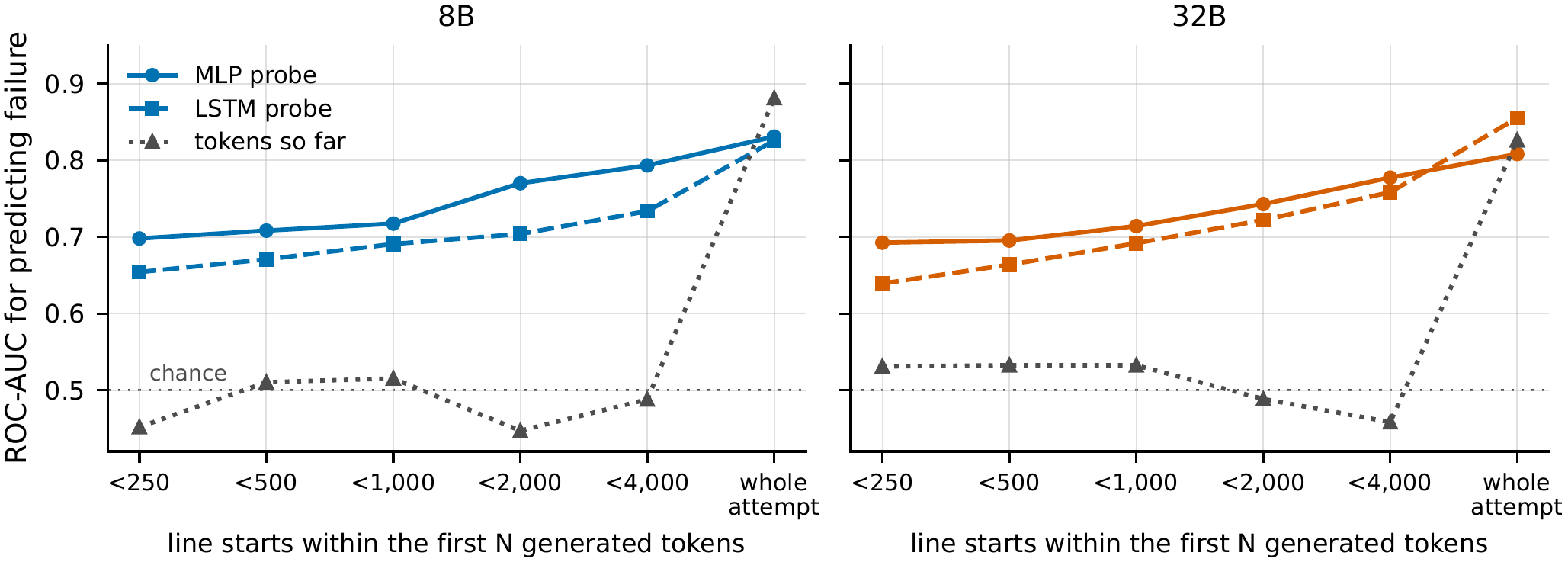
- The signal is real and early — ROC-AUC 0.89–0.92 in leakage-safe cross-validation, 0.81–0.86 out of domain, and 0.64–0.79 from only the first 250–4,000 generated tokens, where a token counter sits at chance. Steering generation on that signal is a reported negative result: 35 of 360 theorems solved versus the base’s 41 on 8B, 59 versus 60 on 32B — neither difference significant (paired exact McNemar, p = 0.109 and p = 1.00), so the hypothesis is unsupported rather than steering shown to hurt. Single run; no confidence intervals. The same protocol reproduces Goedel-Prover-V2’s published 32B pass@32 exactly (60=60), produces the first robustly verified 8B score I know of (41), and rejects a constructed proof of “False” that a long-running Lean server accepts.
Stack Python · PyTorch · Lean 4 · Mathlib · Goedel-Prover-V2 · HPC / Slurm
Code on GitHub → · Read the thesis (PDF) →
- LLMs
- Statistics
-
Agentic Research Advisor
An autonomous agent that reproduces ML papers and is graded on the artifacts it produces, not on what it claims.
- Problem
- Autonomous coding agents will narrate success they never achieved, so running them unattended is a problem of accountability, not capability.
- Method
- A harness that treats on-disk artifacts as the only source of truth, scoring what each run actually produced rather than the agent’s self-report — so incomplete runs and honest negatives become first-class outcomes.
- Result
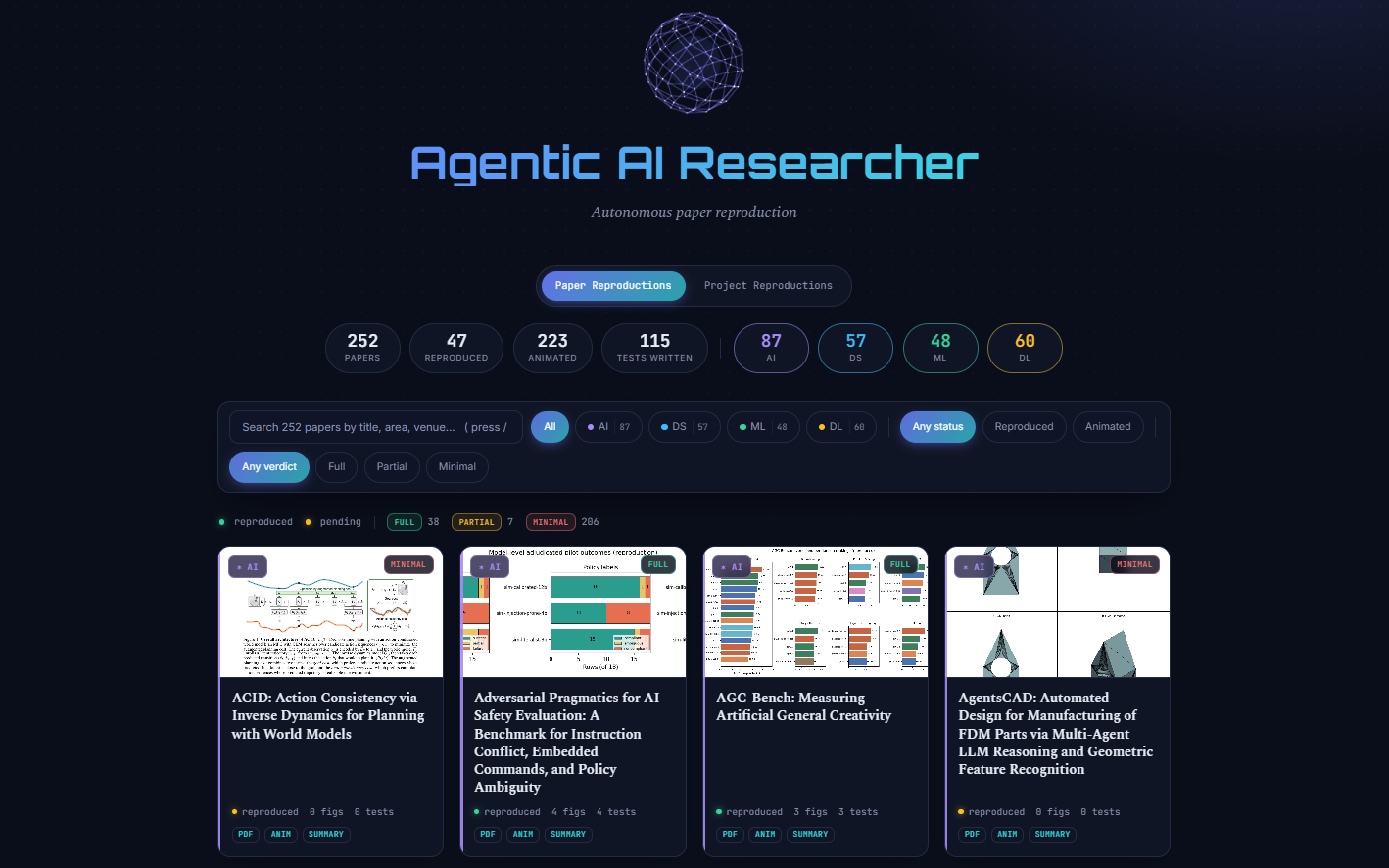
- A searchable reproduction dashboard; as of July 2026, 252 papers ingested and 47 reproduced with full / partial / minimal verdicts backed by per-paper figures and tests.
Stack Python · LLM agents · pytest · static dashboard
- LLMs
- Engineering
-
Gaussian Geometry
Turns three widely-taught covariance “facts” into exact, unit-tested statements.
- Problem
- Covariance is the most-taught, least-understood object in data science, and its geometry hides traps practitioners repeat.
- Method
- Closed-form derivations backed by unit tests and animation, in place of eyeball and Monte-Carlo intuition.
- Result
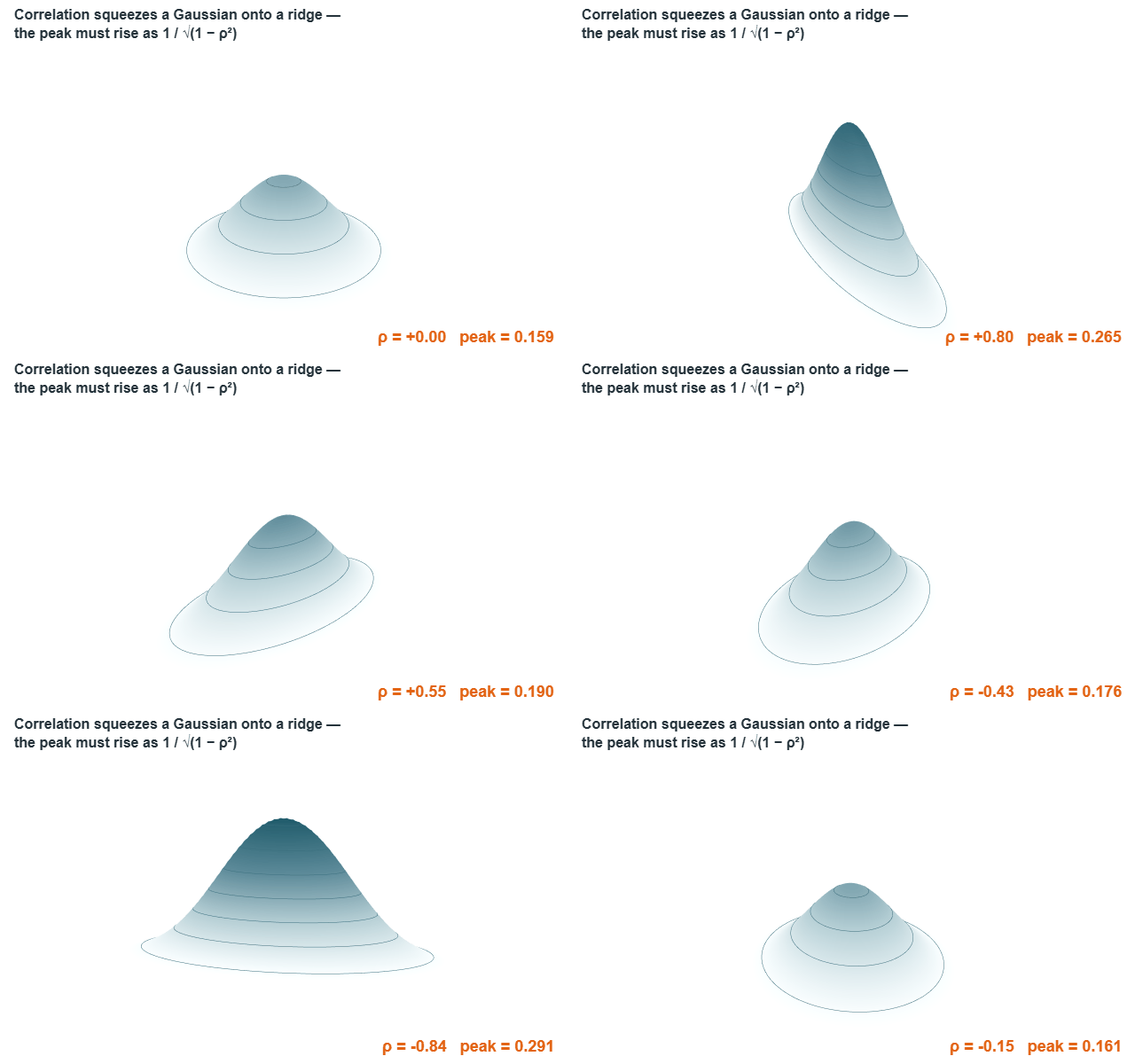
- Rotating a Gaussian and constructing its covariance are the same operation; principal-axis orientation becomes pure noise as the variances equalize; and the “one-sigma” ellipse holds only ~39% of the mass in 2D, not the 68% carried over from one dimension.
Stack Python · NumPy · Plotly · unit-tested derivations
- Statistics
-
Decision Boundary Atlas
Makes SVM overfitting physically visible as the geometry of a decision boundary.
- Problem
- Overfitting is usually argued from the gap between two accuracy curves — hard to see, and easy to miss when validation labels are scarce.
- Method
- A single RBF-SVM kernel-width sweep in 2D PCA space, with the boundary first confirmed two independent ways as a consistency check.
- Result
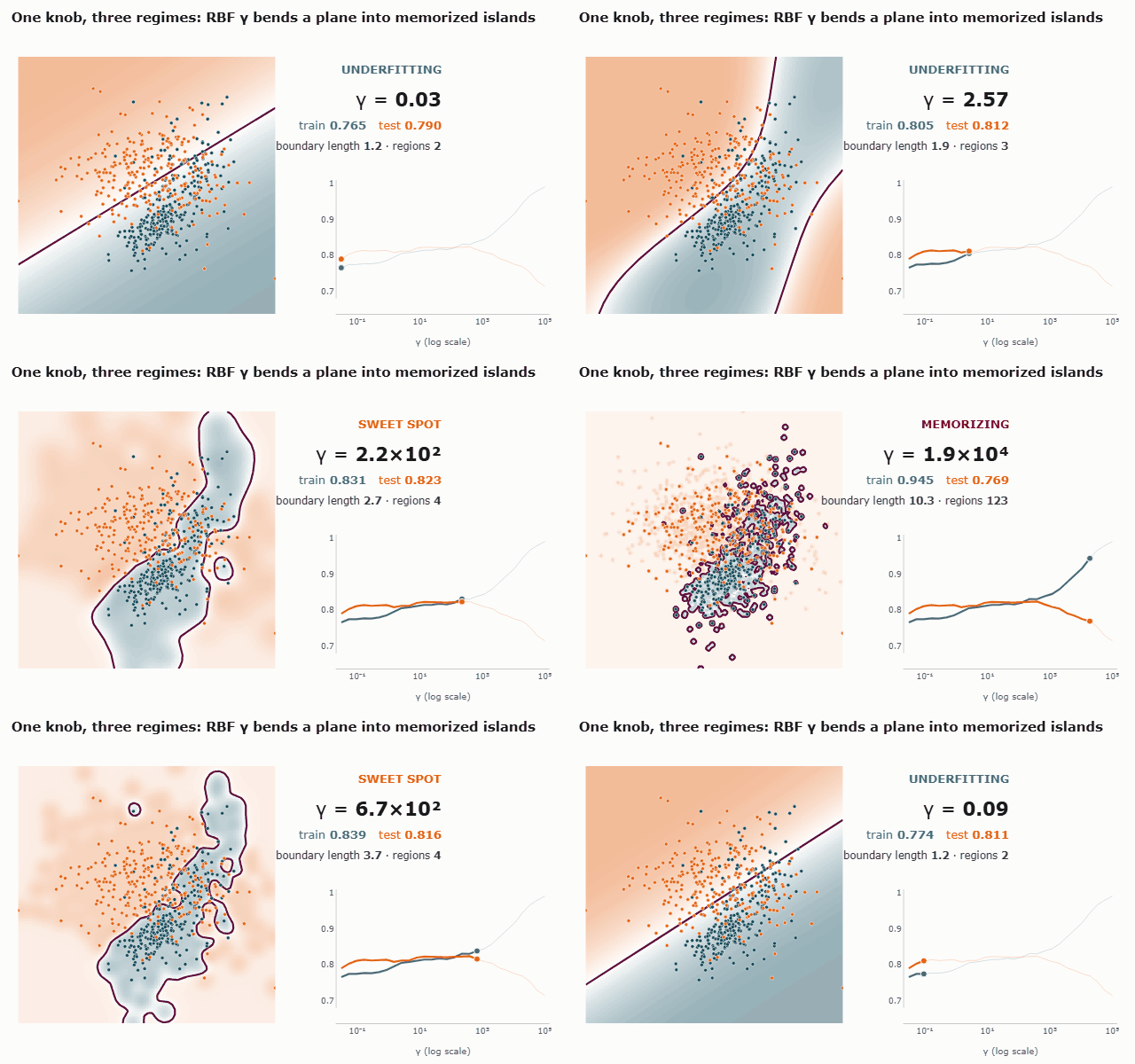
- Added flexibility stretches and fragments the boundary into hundreds of isolated islands exactly as test accuracy turns over — boundary complexity as an early warning for memorization.
Stack Python · scikit-learn · PCA · Matplotlib
- Machine Learning
- Statistics
-
Technical Interviewer
Voice and motion-driven, AI-led technical interview that trains you for the real thing — tailored to your target role and seniority, it asks role-planned questions, holds a real spoken back-and-forth, and does what real interviews never do: scores every answer and hands back a readiness report and study plan. Bilingual (EN/HE); runs fully offline with no API key.
- Problem
- Real technical interviews are scarce and give no feedback: an average corporate opening draws ~250 applicants, ~4–6 are interviewed and one is hired (Glassdoor), and ~94% of candidates who want post-interview feedback never get any. There’s nowhere realistic to rehearse a spoken, role-specific interview and learn from it.
- Method
- A voice-driven mock interviewer tailored to role (Data Scientist / Algorithm Researcher / AI Engineer) and seniority (Junior → Staff/Lead): it plans role-specific questions, listens with real-time barge-in in EN and HE, asks follow-ups and hints, and scores every answer on an 8-metric rubric into a readiness report and cross-session study plan. Production-hardened — every dependency degrades to a deterministic offline engine and the loop resists prompt injection — so it runs fully offline with no API key.
- Result
- A role- and seniority-tailored mock interview that gives the rubric feedback and study plan real interviews never do — resilient, prompt-injection-aware, fully offline, and deterministically testable (221 tests).
Stack FastAPI · React · Gemini · FAISS + MiniLM RAG · pytest
- Engineering
-
TripWise
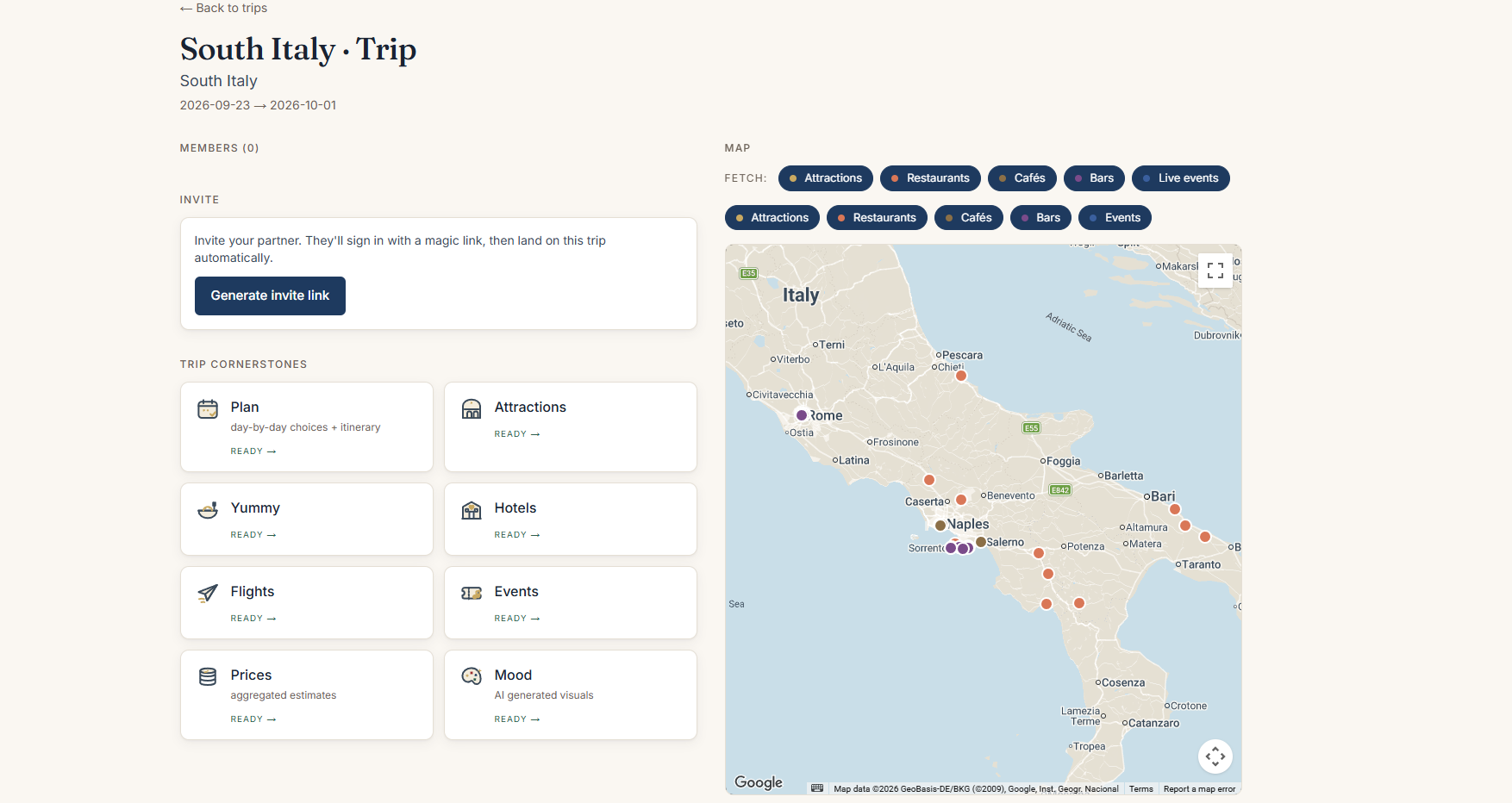
I built TripWise quickly with an AI-assisted (vibe-coding) workflow to plan an autumn trip to Italy with my girlfriend, and it reframes couples’ trip planning as a decision-integrity problem so the first opinion can’t anchor the second.
- Problem
- Shared decisions are distorted by anchoring: the first partner to voice a preference biases the other.
- Method
- Each partner rates options blind; both sets reveal only once everyone has rated everything — and the rule lives in a Postgres row-level-security policy and trigger, not the UI.
- Result
- No client or future frontend can peek early, because the integrity invariant is enforced in the database rather than the interface.
Stack Next.js · TypeScript · Postgres (row-level security)
- Engineering
-
Room Occupancy
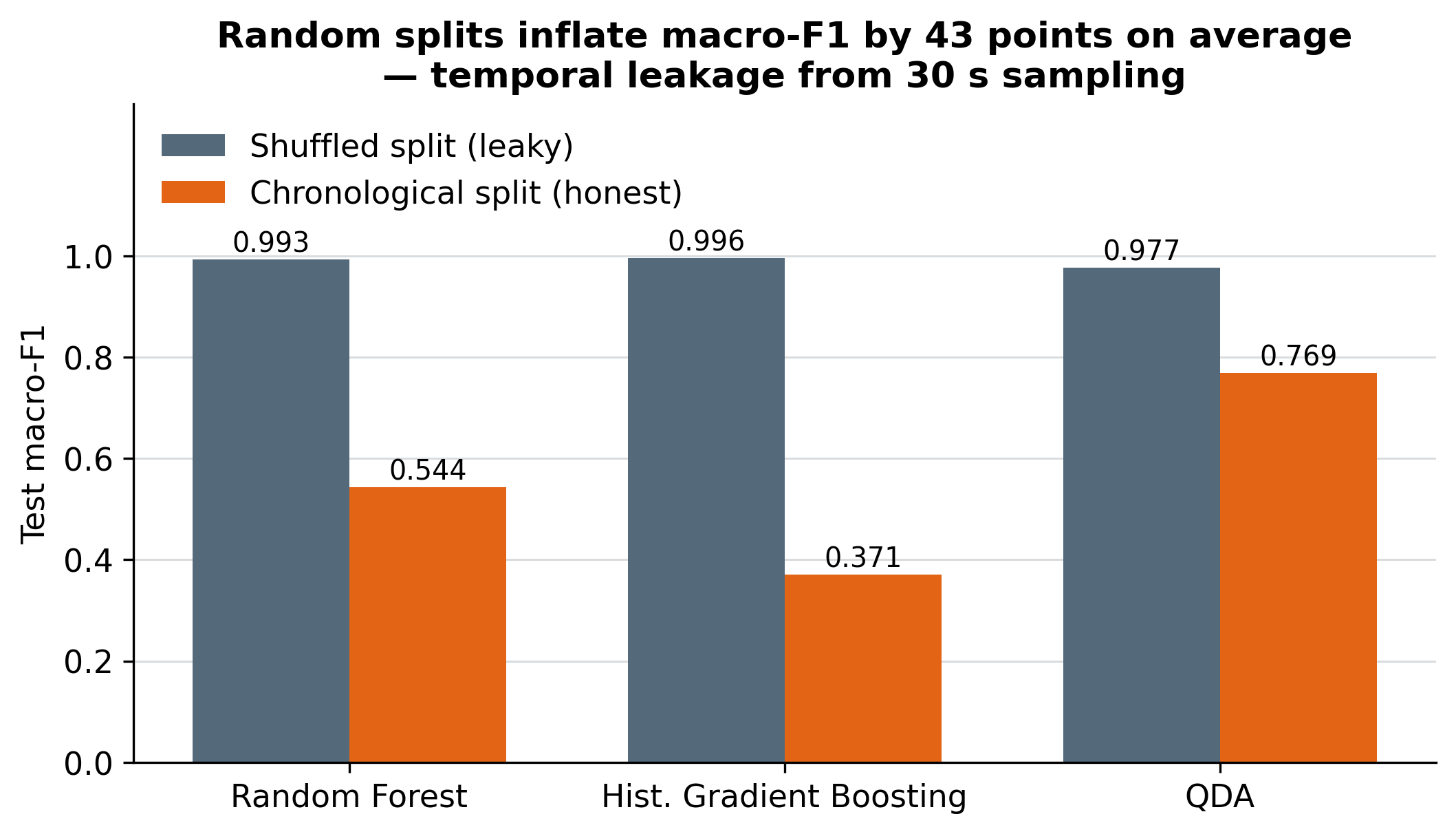
How a shuffled split fabricates skill on sensor time series (macro-F1 inflated 21–62 pts). Under an honest chronological holdout, a simple QDA (~0.77) transfers while tree ensembles don't.
- Problem
- With sensor readings taken every ~30 seconds, a shuffled split drops a near-duplicate of almost every test row into training and inflates the score by tens of macro-F1 points.
- Method
- Compared the shuffled split against an honest chronological holdout — trained on the past, tested on a genuinely later window.
- Result
- Evaluated honestly the task is far harder and shaped by drift between sessions: a simple generative model (QDA, macro-F1 ~0.77) transfers, while tuned tree ensembles built on absolute thresholds do not.
Stack Python · scikit-learn · QDA · signal processing
Code → · Interactive dashboard → · Original paper (IEEE) → · LinkedIn post →
- Statistics
- Signal Processing

Research focus
My research is on machine learning for formal reasoning. My M.Sc. thesis asks whether a theorem prover knows, while it is still writing, that the proof it is producing will fail — and whether that knowledge can be fed back to steer generation. I train small probes, under three million parameters, on the hidden states of a frozen Goedel-Prover-V2, and label every attempt with Lean’s own kernel verdict rather than a proof server’s reply: a proof either type-checks against the trusted axioms or it doesn’t, so nothing is credited for merely looking finished. The signal is there and it is early; the steering is not, and I report that as a negative result.
The same discipline runs through the rest of my work: chronological splits instead of shuffled ones, verifier-checked verdicts instead of a scoring server’s say-so, negative results reported as negative, artifact-scored reproductions instead of agent self-reports, and closed forms in place of Monte-Carlo intuition. It also shows up as system design — invariants placed where they cannot be bypassed. The goal throughout is evaluation you can trust and systems whose results hold up under scrutiny.
Skills
- Machine Learning & Data Science
- Deep learning, reinforcement learning, gradient boosting, anomaly detection, unsupervised learning, feature engineering; PyTorch, TensorFlow, scikit-learn, XGBoost, SHAP
- LLMs & Evaluation
- LLM fine-tuning (LoRA, GRPO), RL with verifier rewards, agentic and tool-use pipelines, Hugging Face, benchmark and baseline design, honest-evaluation methodology
- Statistics & Optimization
- Statistical modeling, experimental design, honest evaluation splits, uncertainty and simulation, mathematical optimization, resource-allocation / operations-research modeling
- Formal Methods & Lean
- Lean 4, Mathlib, kernel-verified evaluation protocols, internal-state probing, verifier-derived labelling, theorem-proving evaluation
- Engineering & Tooling
- Python, pytest, Git, Linux, HPC clusters (Slurm), FastAPI, reproducible pipelines, graceful degradation architecture
- Data & Infrastructure
- SQL, Oracle Client, MongoDB, Postgres (row-level security), GPU-cluster training, dashboards